
Highlights
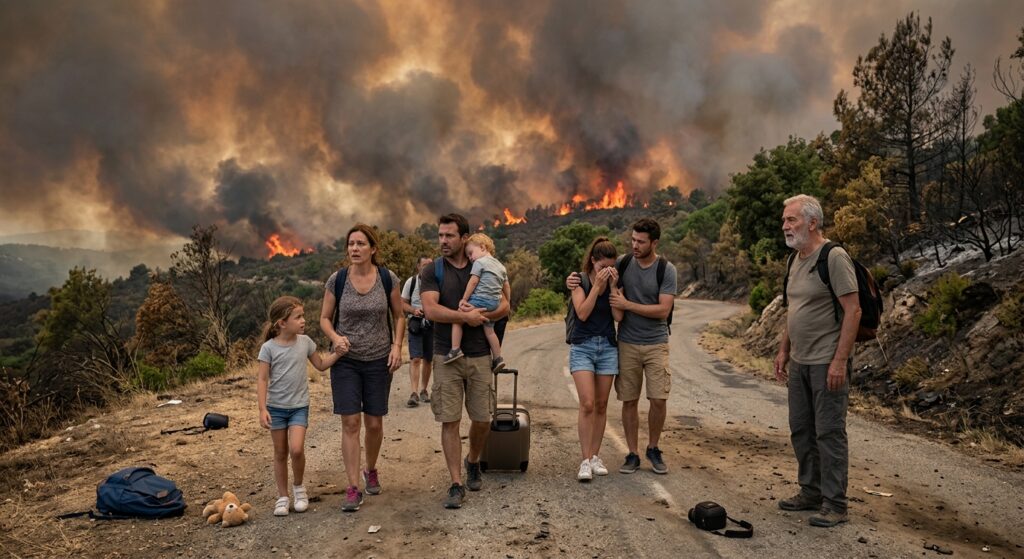
- Families recount their terrifying experiences as wildfires in France disrupt idyllic holiday plans.
- Over 220,000 people have been displaced due to extensive forest fires in southwestern France and central Spain.
- Government officials urge tourists to continue their plans while emergency responses remain in effect.
Escaping the Inferno: A Family’s Race Against Time
In recent days, families vacationing in France have found themselves in a nightmare as rampant wildfires engulfing the region have forced them to hastily evacuate. These fires, fueled by relentless heat and strong winds, have transformed peaceful holiday retreats into chaotic escape zones. Emergency alerts have blared in the early hours, warning tourists to flee the advancing flames. For many, the sounds of sirens and crackling fire have replaced the serene sounds of nature typically enjoyed on a summer getaway.
The wildfires’ devastating reach has sparked declarations of a national emergency in Spain, with over 220,000 individuals displaced from their homes. In France, the military has been deployed to assist in battling the fires, illustrating the severity of the situation. As tourists describe harrowing escapes just mere meters from towering infernos, the once-popular vacation spots now resemble specters of disaster while government officials plead for travelers to maintain their plans and confidence in the safety of unaffected areas.
Fire Fury: The Scale of the Crisis
The wildfires, primarily concentrated in southwestern France and parts of central Spain, have wreaked havoc, forcing families like that of 21-year-old Zac Morrison into emergency evacuation mode. Arriving on vacation just days earlier in Cap Ferret, he received alarming alerts in the early hours, dictating that he must evacuate “by all means necessary.” His experience, however, is not an isolated incident as many others share similar tales of urgency and fear fueled by the proximity of the flames.
Notably, while regions near Bordeaux are impacted, flight operations to cities like Bordeaux and Madrid remain unaffected, providing some relief to travelers. Nonetheless, the acrid smell of smoke has permeated areas far from the direct threat, creating an unsettling atmosphere for those on vacation. As officials continue to monitor the situation, the focus is on battling the relentless fires while encouraging visitors not to abandon their holiday plans.
Facing the Flames: What Lies Ahead
The aftermath of the wildfires is set to be a profound lesson in climate resilience. As communities band together in recovery, the nature of future tourism in these regions might undergo significant changes. The experience has sparked discussions about disaster preparedness and the increasing frequency of climate-related incidents worldwide. Governments are urged to leverage this crisis to enhance their response strategies, ensuring better safeguards are in place for both locals and tourists alike.
In the coming weeks, attention will ideally turn toward rebuilding and restoring not just the physical landscapes devastated by flames but also the spirit of these beloved travel destinations. Developing stronger frameworks for emergency communication and visitor safety will be critical as these regions recover. As travelers reflect on their experiences and the unpredictability of nature, a fundamental question remains: how can we better prepare for the unforeseen impact of climate change on our journey through life?
Conclusion: The recent wildfires in France and Spain have left a deep scar on tourism, with families caught in a whirlwind of chaos as they fled for safety. As the flames continue to threaten, proactive discussions around climate resilience are essential. In the face of this growing crisis, how can we ensure safer travel experiences? Will tourism in these regions ever fully return to normalcy, or will the memory of these fires change how we vacation forever?
Editorial content by Skyler Grey