

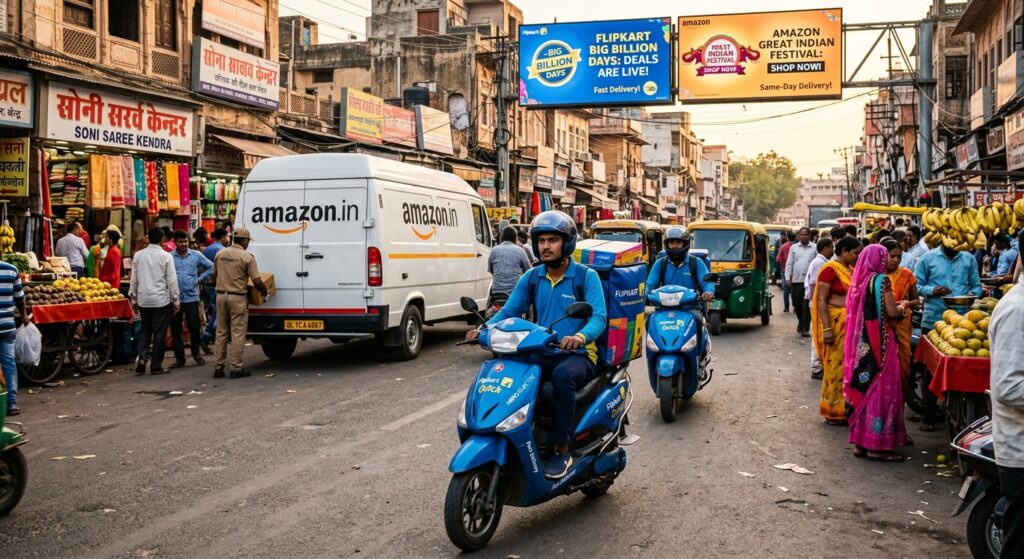
Walmart-backed Flipkart is making waves in India’s e-commerce scene by rapidly expanding its quick-commerce service, Minutes, which now boasts 1,000 micro-fulfillment centers. This development comes at a time when competition intensifies among industry giants like Amazon and Blinkit, all vying to capture the fast-growing demand for speedy deliveries across the vast South Asian market.
With plans to grow its network to 1,500 centers by 2026, Flipkart aims to solidify its foothold in India’s quick-commerce sector, which is experiencing an explosive shift in shopping behaviors and demands.
Highlights
- Flipkart’s Minutes service has established 1,000 micro-fulfillment centers across India, aiming for 1,500 by 2026.
- The quick-commerce sector is rapidly expanding, with competition heating up among industry giants such as Amazon and Blinkit.
- Consumer habits are changing, with increasing demand for a broader range of products delivered quickly rather than just groceries.
The Rise of Quick Commerce in India
The landscape of e-commerce within India is undergoing a remarkable transformation as quick commerce emerges as the latest battleground for major companies. Flipkart, a Walmart-supported platform, has recently announced that its Minutes service has successfully launched 1,000 micro-fulfillment centers in less than two years—a significant milestone that underscores the fierce competition for fast delivery services in the country. With an ambitious plan to expand this network to 1,500 by 2026, Flipkart is positioned to foster rapid growth in an increasingly demanding market.
This newfound emphasis on quick commerce is particularly noteworthy given that India ranks among the world’s fastest-growing markets for this segment. A host of players, including Blinkit, Zepto, Swiggy Instamart, and Amazon, are investing heavily in infrastructure to cater to consumer desires for instant access to a wide range of products, from groceries to electronics. Companies are not only competing over market share but also redefining consumer expectations regarding delivery speed, service offerings, and overall shopping experience.
Expanding Market Dynamics
The core of Flipkart’s strategy revolves around adapting to changing shopping patterns. Kunal Gupta, head of Flipkart Minutes, revealed that demand is no longer restricted to essential items like groceries; there’s a growing appetite for products in the beauty, electronics, and personal care categories. As a testament to this shift, the platform has recorded a remarkable 400% growth in orders compared to the previous year, alongside a 20% increase in customer retention. Gupta noted that “what began as a way to fulfill everyday essentials has evolved into a fundamentally new shopping habit for millions of Indians.”
Flipkart’s reach has thus extended into over 130 cities and more than 8,000 postal codes, especially beyond the major metropolitan areas. This expansion has been met with impressive results, particularly in smaller cities like Patna and Guwahati, where Flipkart’s offerings are gaining traction at an astonishing rate. This trend highlights a larger movement within the industry, where demand outside India’s major urban centers is becoming a pivotal focus for growth, with companies like Amazon noting that a significant portion of their new Prime members are emerging from these smaller markets.
Looking Forward: Implications and Opportunities
The rapid escalation of quick-commerce services presents numerous implications for the future of retail in India. Companies are racing to transform quick delivery options into comprehensive shopping platforms that cater to a wider array of consumer needs. The expected growth in the number of micro-fulfillment centers—from over 5,500 to approximately 7,500 by 2030—illustrates the industry’s commitment to evolving consumer preferences and enhancing service delivery across all demographics.
Furthermore, Flipkart’s ongoing commitment to opening an additional 75 to 100 micro-fulfillment centers each month indicates a strategic investment in scaling operations while continuously engaging a diverse customer base. As Gupta emphasizes, there is no intention to slow down, signifying aggressive competition aimed at establishing a robust presence in India’s retail landscape.
In summary, Flipkart’s expansion of its Minutes service amidst a battleground of quick-commerce offerings underscores a significant shift in India’s shopping landscape, driven by evolving consumer preferences and intense market competition. With companies like Amazon and Blinkit in the mix, the future of retail in India is ripe with possibilities. What does this growth mean for traditional retail models? How could consumer behavior continue to evolve in light of these rapid changes? Where do you see the next battleground emerging in Indian e-commerce?
When you purchase through links in our articles, we may earn a small commission. This doesn’t affect our editorial independence.
Editorial content by Casey Brown